SF Inspiration #10: Communication today: Were Watzlawick & Co. wrong?
SF Inspiration #10: Communication Today: Were Watzlawick & Co. Wrong?
by Dominik Godat & Elfie J. Czerny

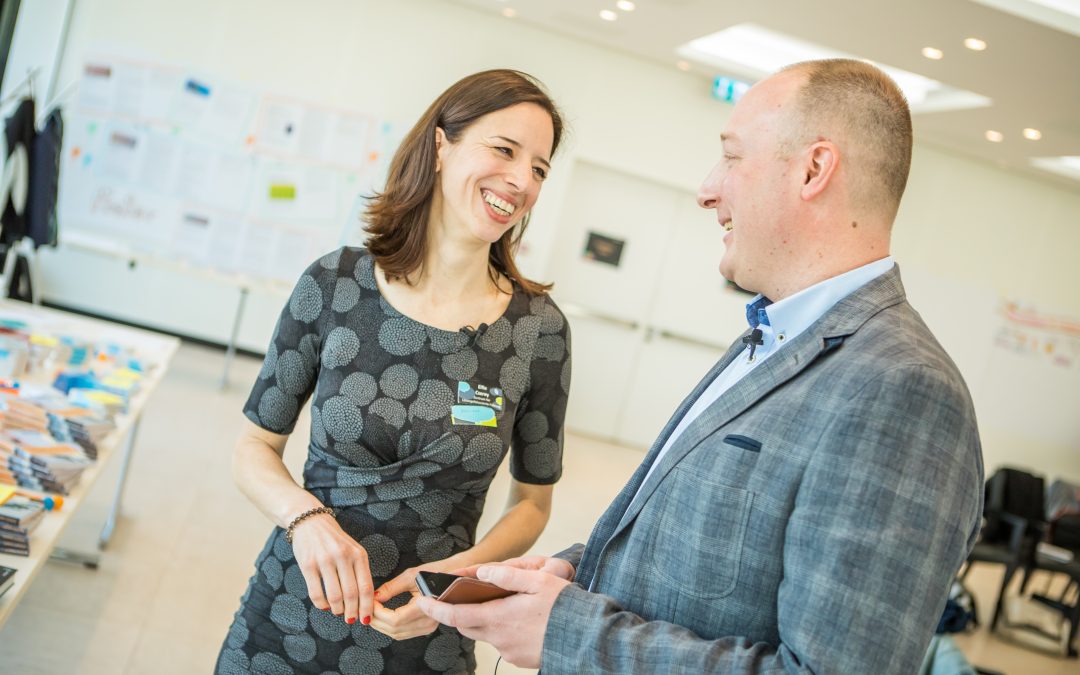
Photo taken by Andreas Lattner at the first Conference for Solution Focused Leadership hosted by Elfie & Dominik in 2016 in Lucerne: Elfie Czerny & participants discussing communication today: from the sender-receiver model to co-construction.
Communication today: Were Watzlawick & Co. wrong?
This article was originally published in German on the Leadership Network Lucerne Blog of the University of Applied Sciences Lucerne. With big thanks to Heather Fiske for her support in editing the English version of the text – Communication Today: From the Sender-Receiver Model to Co-Construction.
The sender-receiver model and the 5 axioms of communication have influenced how communication is spoken about and how communication is taught for more than 50 years. This influence has persisted despite the fact that recent research calls some of these ideas into question. So, were Watzlawick & Co. wrong?
Technology Metaphors and Their Influence on Communication Models
The sender-receiver model is a classic communication model on which many communication theories that are still in use today are based. It was developed as information theory in the 1940s by the two telephone technicians and mathematicians Claude E. Shannon and Warren Weaver [4].
And as is so often the case, the existing technology shaped the theoretical considerations. The metaphor, which is still used today, describes communication as a transfer process in which one person sends information and another person receives and decodes it. This idea was directly derived from the telephone technology of that time.
Watzlawick, Beavin, and Jackson were particularly interested in the observable interactions in human relationships that result from an interpersonal sender-receiver relationship [5]. With their 5 axioms of communication, which they formulated as hypotheses in 1967, they investigated these interactions. With terms such as information, feedback, black box, redundancy, and cybernetics, they too based their ideas on the telecommunication and control technology of that time.
Things have changed in 50+ years
Much has changed in more than 50 years. On the one hand, we live in a technologically different world today, with potentially new metaphors. On the other hand, we also have 50 more years of experience and research in the field of communication. And who could judge this better than Janet Beavin Bavelas herself, who was co-author in 1967 and who has evaluated the hypotheses of past decades as a communication researcher? When we asked her what has changed since 1967, she gave the following answer: “It was my goal to become a research psychologist. (…) And so, I have done that for 4-5 decades of my life. And that changes things. If it didn’t, we’d really be worried. If I’ve been looking at data for that long, and I found exactly what we said was happening in “Pragmatics”, I would be cheating. (…) In fifty years a lot of things have happened. (…) Some [of the axioms] have worked pretty well, others do not. » [6]Communication today: Ongoing co-construction instead of sending and receiving
How can we describe communication in a contemporary way? Bavelas and her research team provide answers. With Microanalysis of Face-to-face Dialogue, they have in recent years developed a video-based conversation research method that reveals what actually happens in conversations moment by moment. What they have discovered is that communication is much faster and more mutually created than what we would expect based on a sender-receiver model. They show that conversation partners influence each other every few seconds. Thus interlocutors co-construct the conversation together [7]. Conversation partners influence each other, for example, with their statements and formulations; with their questions; with their co-speech gestures; and with their generic and specific listener responses. Any of these influences can occur not just after something has been said, but continuously while the person is speaking. Microanalysis research can show, for example, that the way we listen strongly influences what the other person says [8]. With this understanding, our idea of conversation changes from something that happens in individual turns to something that we do together on an ongoing basis.Co-creating together
This difference between a view of communication as an alternating sending and receiving, and a view of communication as something we do together moment by moment, may seem trivial at first glance. However, this difference has potentially world-changing implications. While the traditional view of communication focuses on sending and/or receiving, this new view raises the question of how we interact together. Imagine the differences it would make if everyone realized that they, as conversation partners, are always jointly responsible for what happens; that they influence conversations just as much as their conversation partners; and that this responsibility and influence exists even if they are “only” listening. In this view of communication, the result of a conversation can no longer be assigned to just one person but is always jointly created. Statements like “My employees only talk about problems.” or “He talked all the time.” would change to “How can we interact more usefully together?” We cannot blame one conversation partner for either the content or the course of the conversation: Both parties are always involved.- English: sfontour.com/microanalysis
- German: sfontour.com/mikroanalyse
The Authors
This article was written by Elfie Czerny and Dominik Godat, communication and leadership experts, Interactionalists, and promoters of solution-focused practices. They are co-editors of the magazine Persönlichkeit! and co-founders of SF on Tour. Learn more at www.sfontour.com