
SF Inspiration #15: Moving Forward Together In Dialogue
Elfie J. Czerny & Dominik Godat
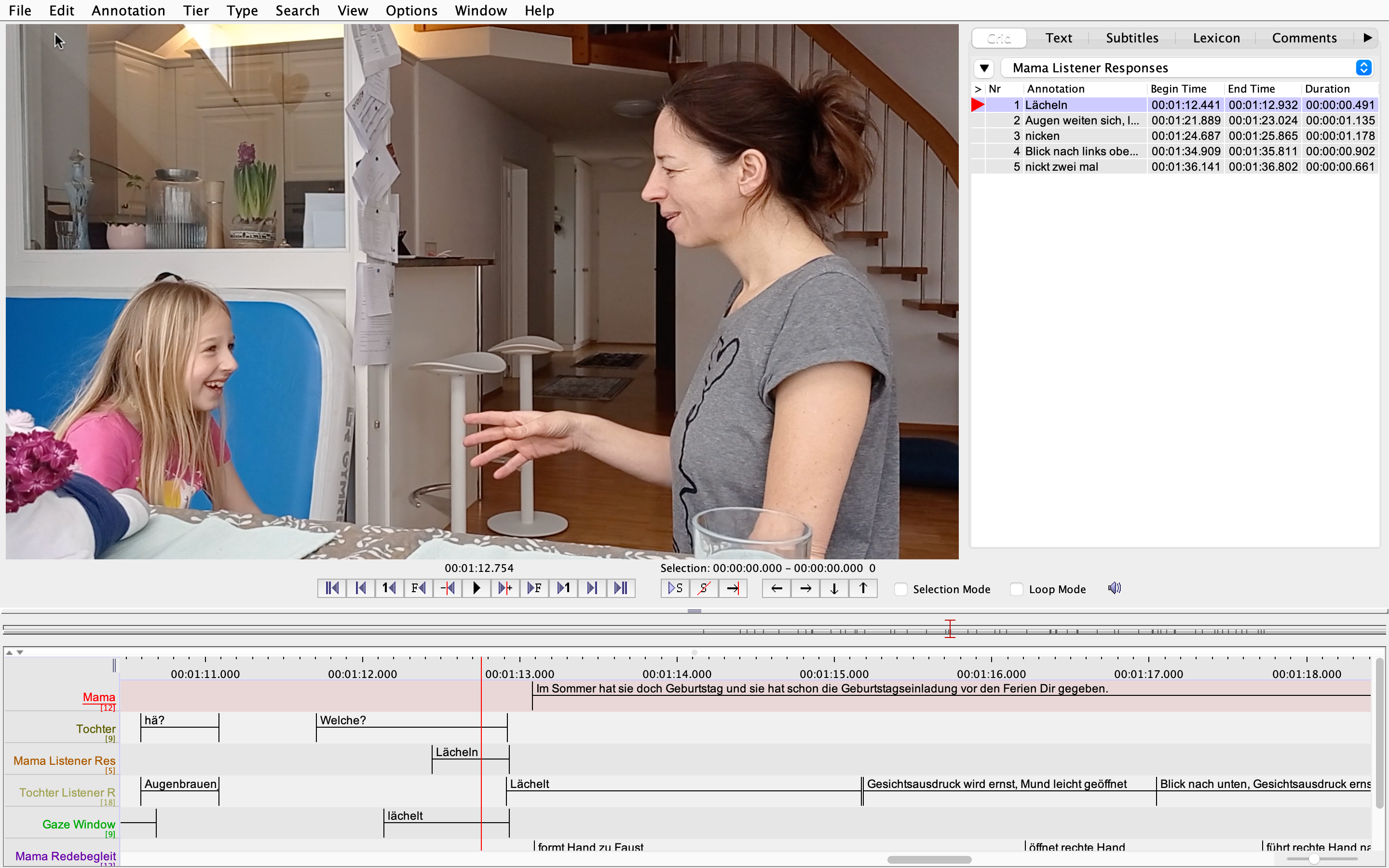
Moving Forward Together in Dialoge
The article “Moving Forward Together in Dialogue” first appeared in May 2024 in our monthly magazine Persönlichkeit – Schritt für Schritt entwickeln und entfalten, published by WEKA Business Media AG, under the title “Im Dialog gemeinsam in Bewegung.”
In face-to-face conversations, we do far more than previously assumed. We are in constant motion together—moment by moment, millisecond by millisecond. Join us in exploring how you can begin to perceive this shared movement in dialogue.
Focus on the Individual
We are trained to observe what each individual does. When we look at conversations this way, we see alternating monologues. One person speaks, the other listens. Then the second person speaks. It appears as though the speaker and the listener are acting independently. From this, we try to draw conclusions about good communication—based on the formula: 1 + 1 = 2 [1].
Dialogue as Alternating Monologue
Imagine you’re in a conversation with a colleague who is assigning a task to you. The goal is for you to understand the assignment well so that you can carry it out effectively. If we observe your colleague (the speaker) and you (the listener) as separate individuals, we are likely to conclude that your colleague independently selects the statements that best convey what she wants to communicate. She then sends these statements to you, the receiver. Your role as the listener is simply to correctly decode her intended message. From this perspective, your colleague speaks as though she were writing to a distant reader [2].
Focus on Interaction
When we shift our focus to what people do together—to their interactions—we begin to notice how much more dynamic dialogue really is. From an interactional viewpoint, conversations are no longer individual performances for an audience. They become coordinated activities—more like a jazz duet than a solo recital.
Referential Communication
Referential communication brings this joint activity into focus. When we talk with one another, we are constantly referencing each other. A successful exchange of information depends not only on the quality of the speaker’s statements but also on the participants’ ability to coordinate and refer to one another effectively.
In the 1980s, American psycholinguist and Stanford professor Herbert Clark, along with colleagues [2] [3], investigated whether conversations are unilateral actions governed by a single speaker—or whether they might, in fact, be collaborative processes shaped by both speaker and listener. Their research convincingly demonstrated that what matters is not one-sided transmission, but dialogue itself. We continually respond to one another—and we do so in ways uniquely co-created with our respective conversation partners [4].
Dialogue as a Joint Process
Recently, we were having lunch with our daughter. She was telling us about school, and I asked her about a classmate whose name I couldn’t recall. In the excerpt below, you’ll see how she and I co-constructed the name of her schoolmate together—in about 30 seconds.
This brief example shows how quickly and efficiently we coordinate in conversation, working together moment by moment to reach a shared understanding.
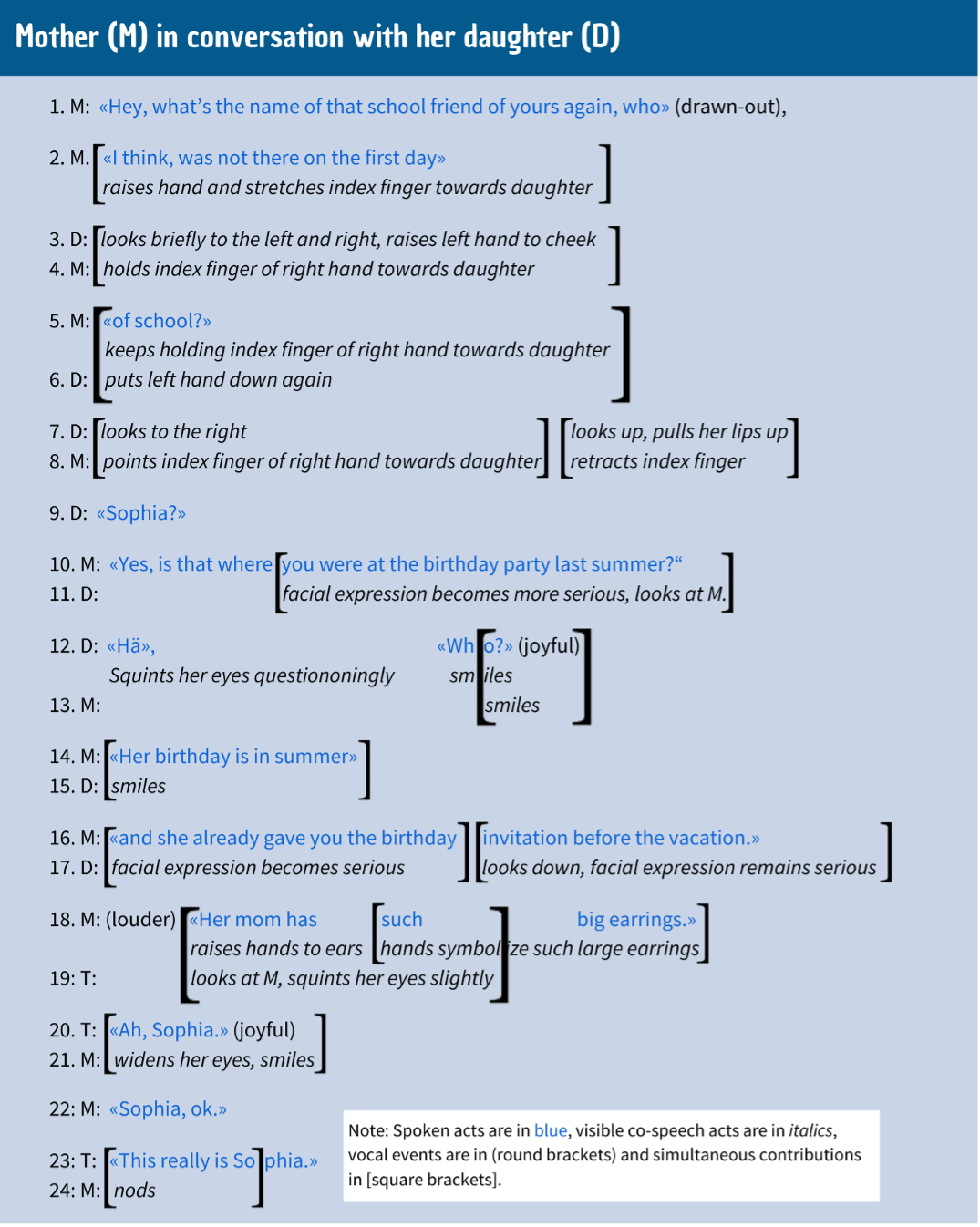
After our daughter asked, “Who?” (line 12), I continued in line 14, “Her birthday is in summer.” She smiled. I added, “And she already gave you the birthday—” and then “invitation before the vacation.” As I began saying “and,” she stopped smiling and her facial expression turned serious.
I continued with “invitation,” and she looked down with a serious face. Her behavior signaled that we hadn’t reached shared understanding yet.
I then added, “Her mom has such big earrings.” My words were accompanied by a gesture—I raised my hands to my ears and pointed to them at “so big” to represent the earrings. As I began speaking, our daughter’s eyes turned toward me and she squinted slightly. Immediately after I finished, she said joyfully, “Ah, Sophia,” just as I widened my eyes and smiled.
You could read this transcript as if it were composed of alternating monologues—but that would be a misreading. Our contributions overlapped frequently, yet we stayed closely coordinated. Many of our contributions—especially shifts in facial expression—occurred simultaneously. We co-created the dialogue, second by second. And yet, this dynamic is difficult to capture in a transcript.
Movement in Conversation
The degree to which we move together in conversation is difficult to notice in real time. Dialogue partners build and shape their conversation collaboratively, through actions that occur in seconds or even fractions of a second, in the ever-flowing stream of interaction.
This perspective has significantly changed how we think and act. For example:
- We talk differently about conversations: “You said…” becomes “We talked about…”
- We pause with intention: In our conversations, we often pause briefly and continue only once we’ve received a signal—like a nod, a “m-hm,” or a “yes”—that we are moving forward in the conversation together.
- We turn our attention toward the other person: The more attentive and attuned we are in conversation, the more effectively we can create shared understanding.
What might this perspective open up for you?
- What difference might this perspective make in your conversations?
- And how might it change the way you talk about what you do when you’re in dialogue?
Further training on the topic
Join our Microanalysis online course and get to know what really happens in dialogue:
- English: sfontour.com/microanalysis
- German: sfontour.com/mikroanalyse
[1] Bavelas, Janet B. (2022). Face-to-Face Dialogue. Theory, Research, and Applications. (p. 71) New York: Oxford University Press.
[2] Clark, Herbert H. & Wilkes-Gibbs, Deanna (1986). Referring as a collaborative process. Cognition, 22(1), 1-39.
[3] Schober, Michael F. & Clark, Herbert H. (1989). Asking questions and influencing answers. In Judith M. Tanur (Ed.) Questions about questions: Inquiries into the cognitive bases of surveys (pp. 15-48). New York, NY: Russell Sage.
[4] Bavelas, Janet B. (2022). Face-to-Face Dialogue. Theory, Research, and Applications. (p. 73-75) New York: Oxford University Press.
The Authors
Elfie Czerny and Dominik Godat are communication and leadership experts, Interactionalists, and passionate advocates of solution-focused practices.
They are co-editors of the magazine Persönlichkeit! and co-founders of SF on Tour. Together, they lead the expert leadership course Fachkurs für Lösungsfokussierte Führung at the Lucerne University of Applied Sciences and Arts.
👉 Learn more: www.hslu.ch/loesungsfokus
0 Comments